

Every AI company is suddenly hiring Forward Deployed Product Managers and named: FDPM.
Two years ago the role barely existed and today it is one of the hardest seats to fill in AI, and one of the most misunderstood.
I’ve checked around and most PMs cannot define it, and plenty of the people already doing it cannot say cleanly how it differs from the job they left.
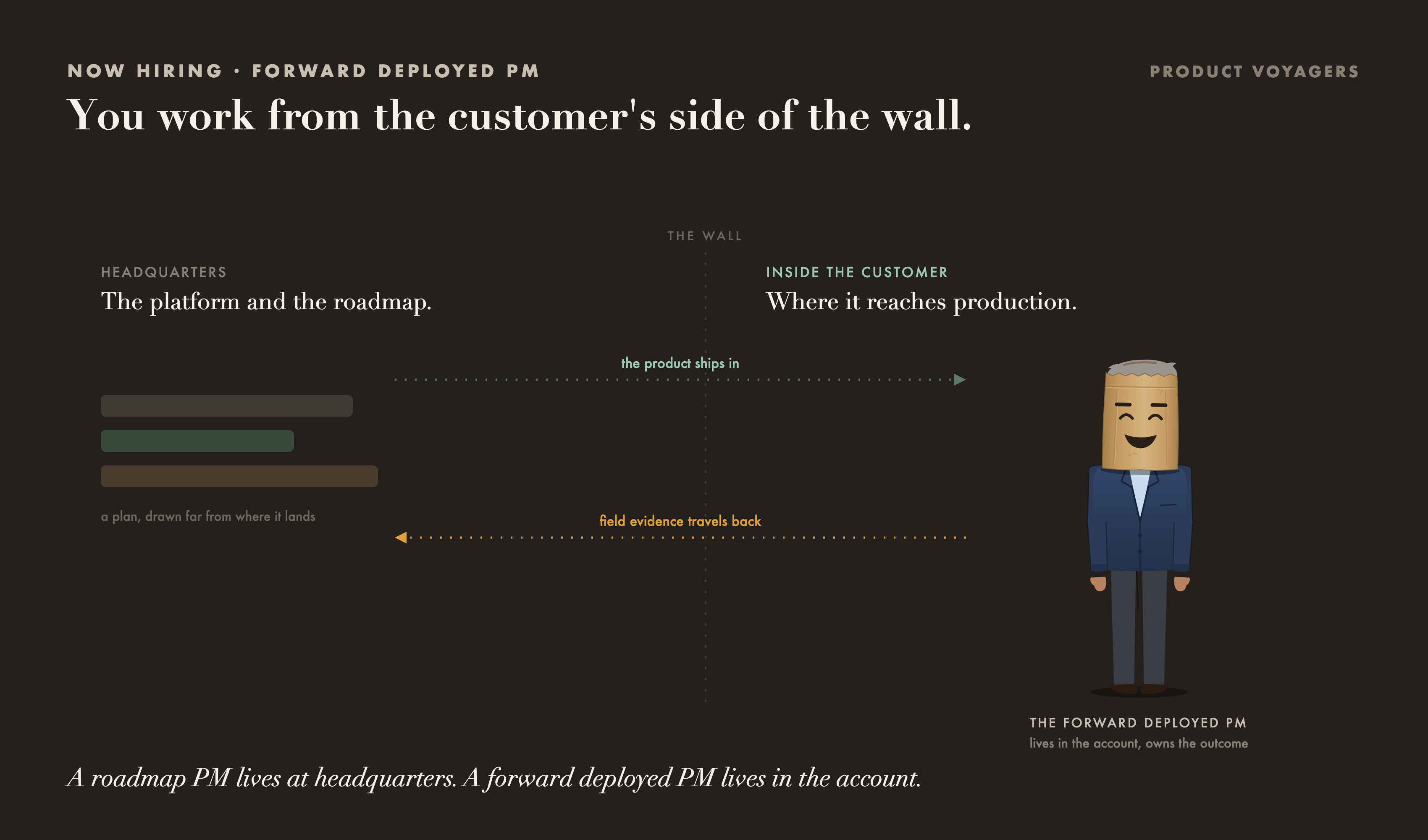
The difference is simpler than the title makes it sound. A FDPM is still a product manager, but instead of sitting with the platform team drawing a roadmap, you live inside a handful of customer accounts, in their building and their problem. You are measured on one thing: did the product reach real use and create real value there. So, we’re not talking about a pilot or a demo that looked great and died right after, but production, with people depending on it.
The name borrows from forward-deployed engineering, where engineers leave the mothership and embed with the customer to make the thing actually work. The product version is newer, and it exists for a reason sharp enough that the rest of this piece is about it.
Most people think a forward deployed PM is just a PM who travels a lot.
The only one who changes the product
But wait? where is the confusion? Confusion comes from what’s the difference between FDPM, Customer Success Manager CSM or an Account Manager AM, they look the same!
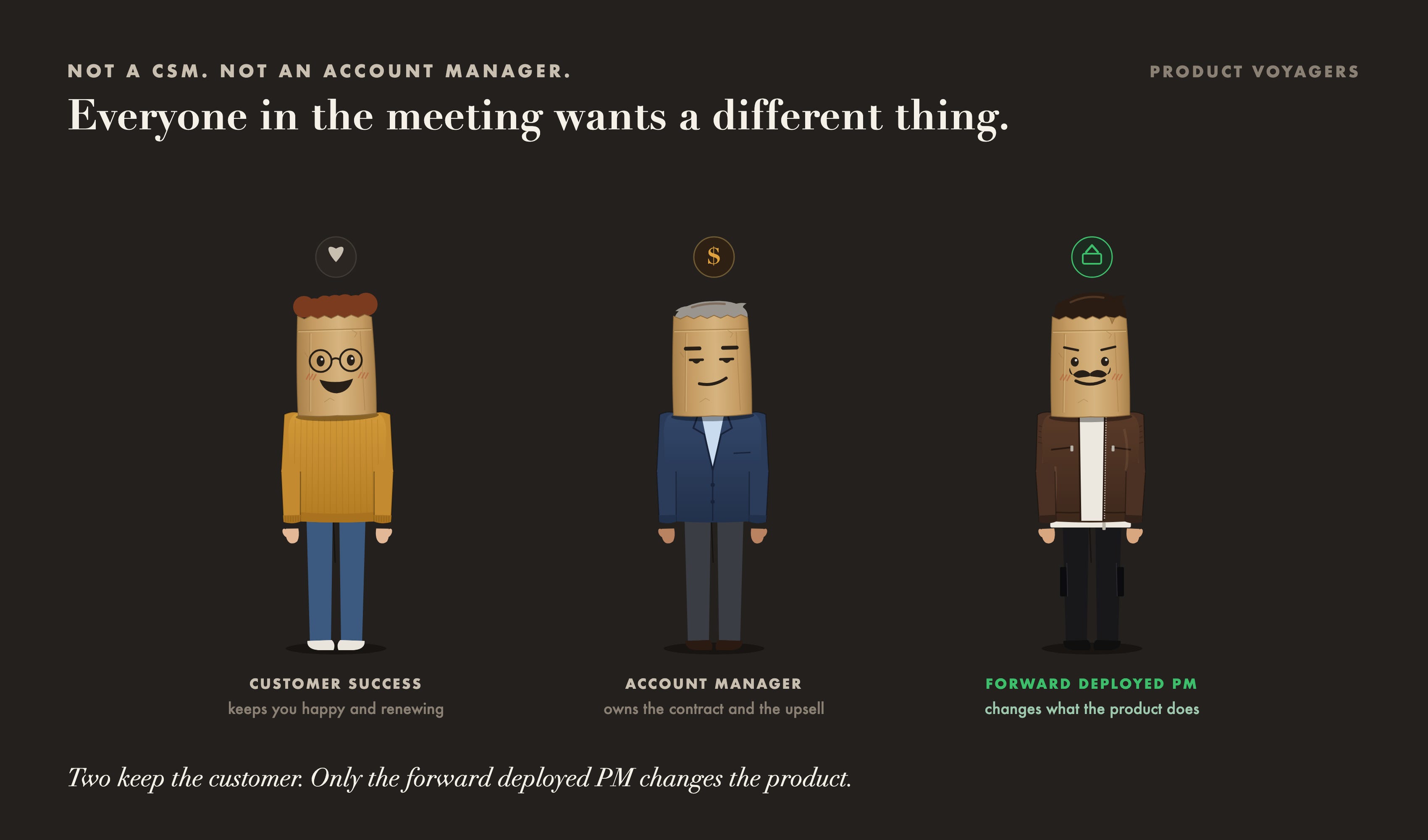
In fact, 3 people can sit in the same customer meeting and each want something different from it. Customer success “CSM” keeps the customer happy and renewing, working with the product exactly as it is. The account manager “AM” owns the contract and the next upsell.
Both matter, and neither can change what the product does. The forward deployed PM is the only one in that room whose job is to take what the account reveals and change what the platform builds. That is the line that separates the role from the two it keeps getting confused with.
More confused, on what’s the difference to a PM
A roadmap PM is judged on what ships. A FDPM is judged on what sticks.
Those sound similar and they are not. While shipping is an event on your side of the wall, but sticking is a state on the customer’s side, weeks later, when the thing is still running and someone would complain if you switched it off.
So the clock does not stop at launch; however, It runs from the contract to the day the customer depends on the product, and everything in that gap is yours: the integration that will not connect, the data that arrives dirty, the team that does not trust the output yet.
You carry the account from signature to production, and a pilot that impressed everyone and changed nothing counts, honestly, as a loss.
A key skill for FDPM: Tell the product gap from the people gap
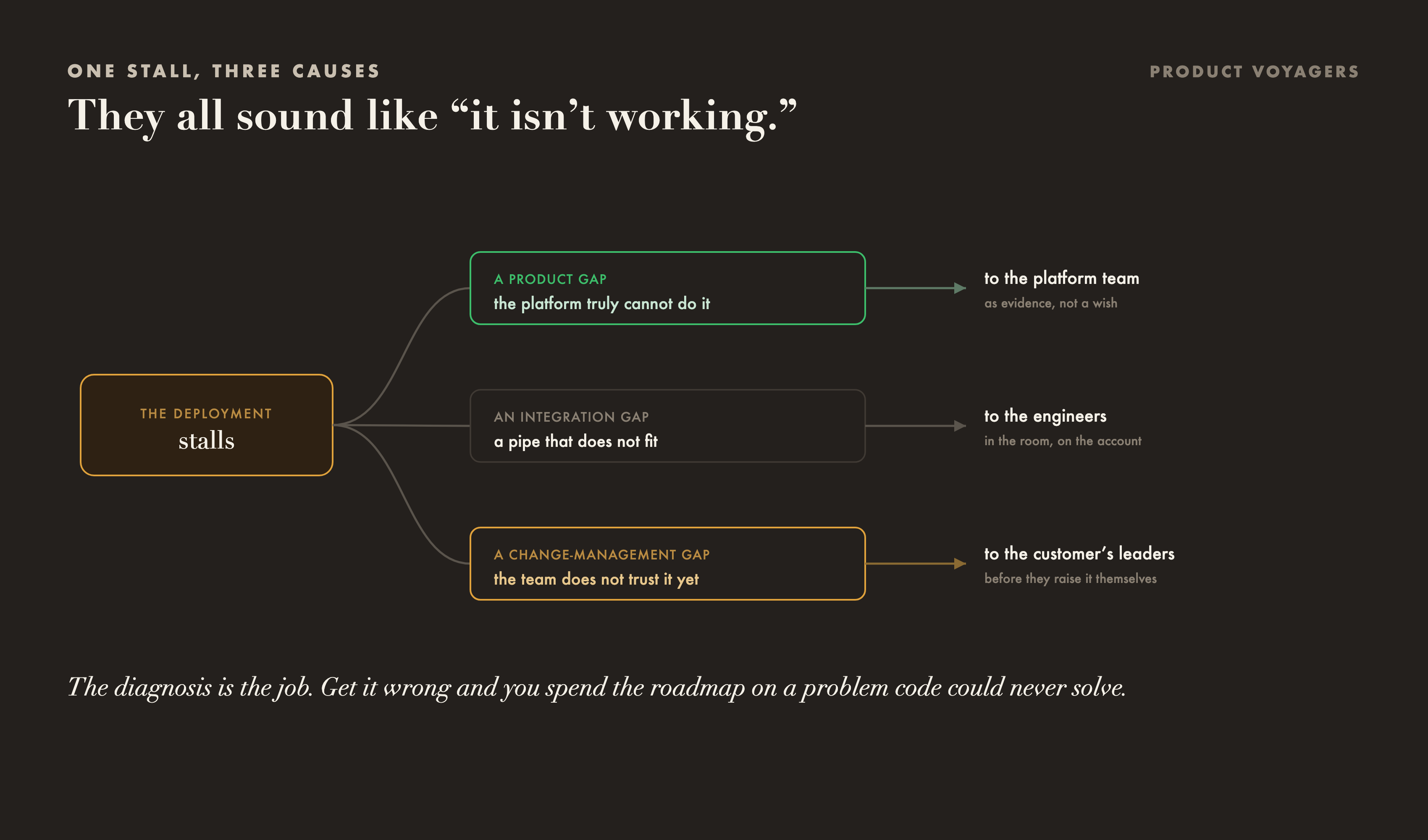
This is the skill the whole role rests on. When a deployment stalls, something is blocking it, and the something is almost never just one thing. It could be
Product
1/ a real product gap,
2/ a capability the platform genuinely does not have.
Integration
3/ it could be an integration problem,
5/ a pipe that does not fit.
People
6/ It could be change management,
7/ a customer team that does not trust the output
Or 8/ has not changed how they work to use it.
All these feel identical and they all sound like “it isn’t working” and this where FDPM is the person who can tell them apart and route each to the right fix.
Carry evidence home, and not requirements
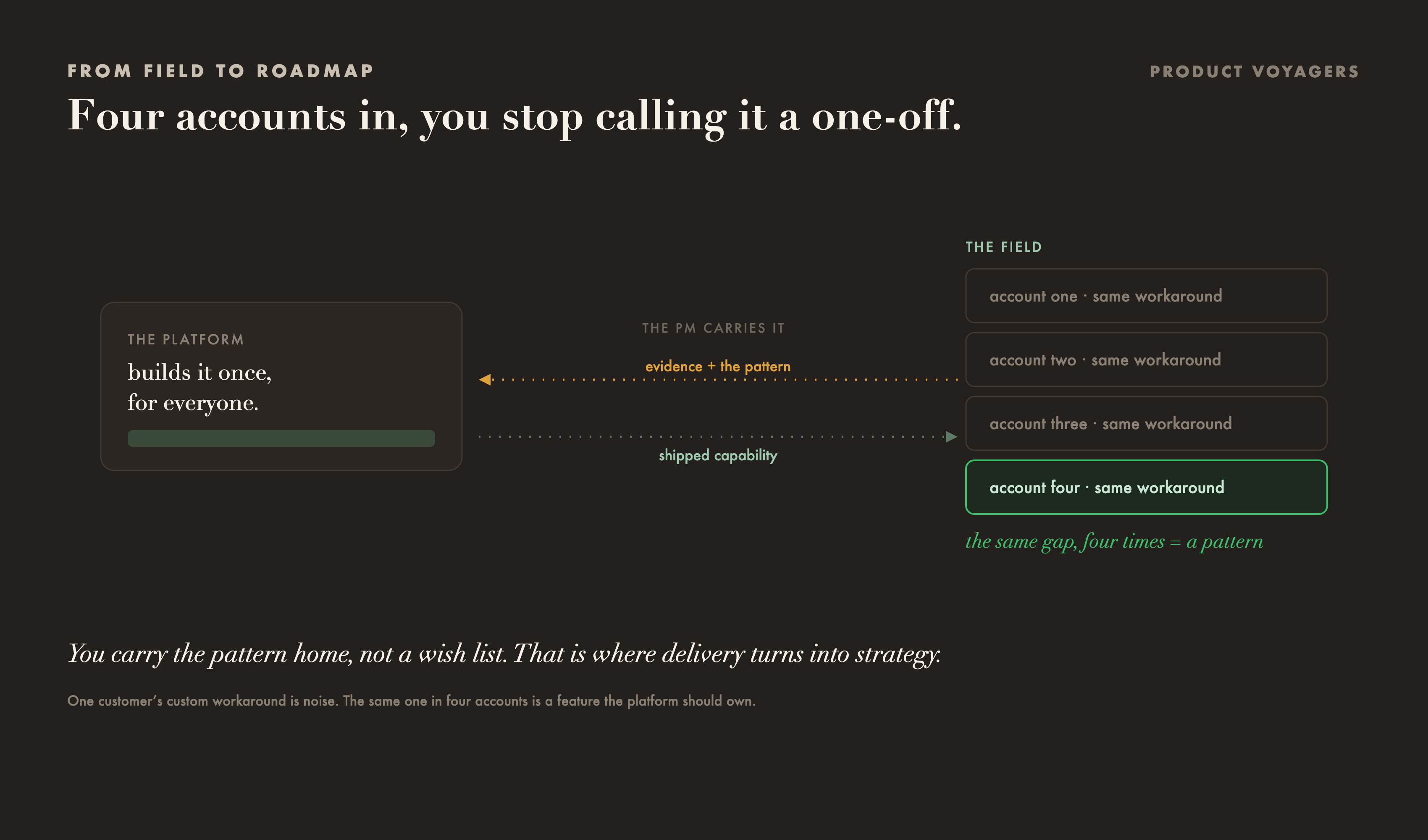
The field is where you learn what the product is missing, but learning it is not the job. Changing the platform is.
So you go back to the core team with something sharper than a requirements document. Not “the customer wants X.” Instead: here is what happened in production, here is the specific gap, here is the tradeoff, and here is why it matters beyond this one account.
That pattern-spotting is where the role stops being delivery and starts being product strategy.
No authority, total ownership
You run the account as one team with the engineers, not as a PM supervising from a distance while the build happens in parallel. One team, one outcome.
And you do all of it with almost no formal authority (same to any PM role, right?) You cannot order the platform team to build your feature, you cannot order the customer to change their process.
What you have instead is credibility, built by being right in the room, making fast calls on thin information, and knowing enough of the technical reality to argue an architecture tradeoff with an engineer without pretending to be one.
Hint: You do not need to write the production code, however you need to know how to evaluate your product quality onsite with your customers with real use cases.
This is also where evals quietly enter. The question “is this agent good enough to ship to this customer” is one you answer constantly, and you answer it with evidence, not a feeling.
The forward deployed PM who can define what good enough means for a specific account, and show it, is the one the customer trusts and the platform believes.
Hereby a guide of how you can build AI products with Evals.
A Complete Guide to Evals, from a Real Product

Two words are going to keep coming up, and both are simpler than they sound.
The same job in three places
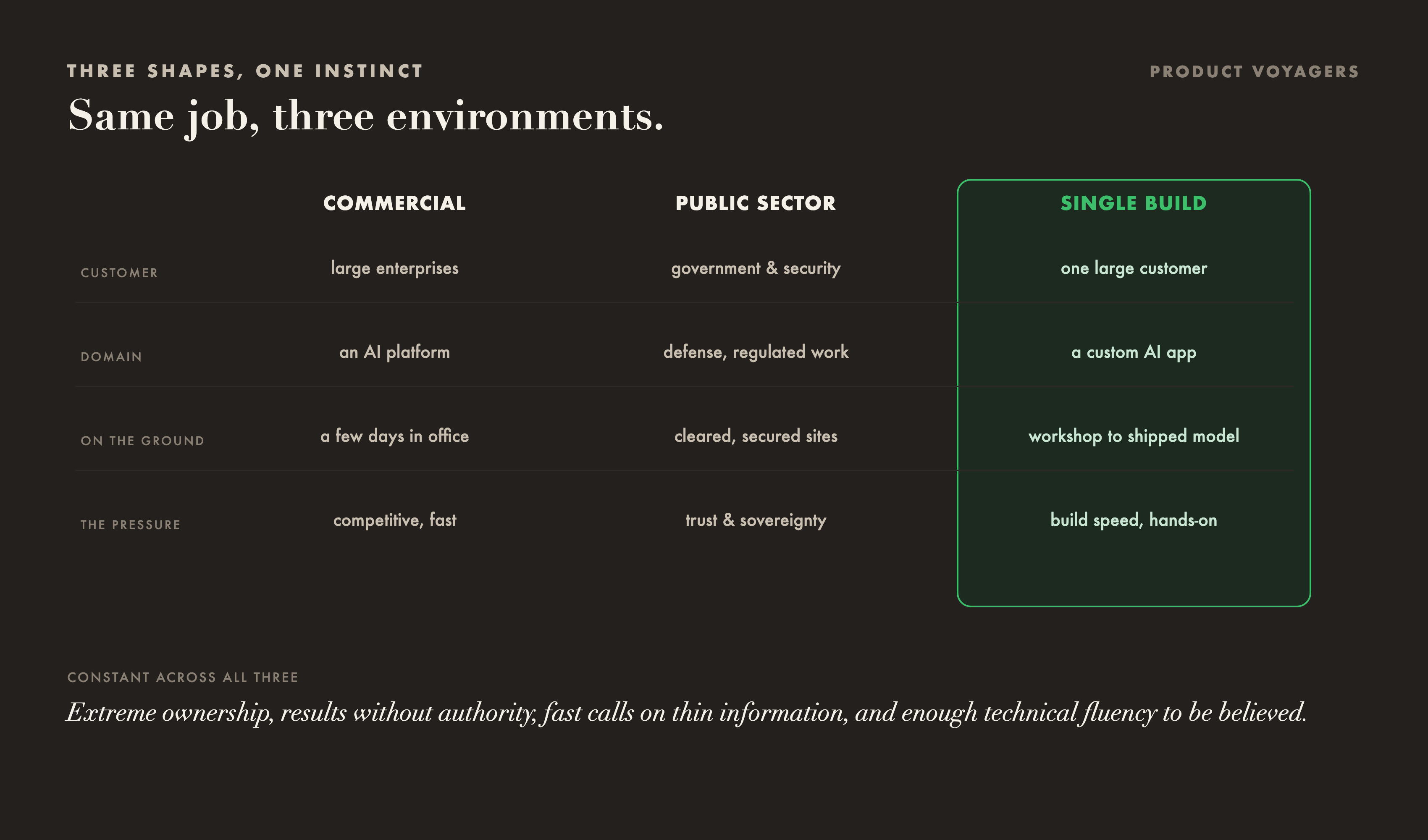
So, the role shows up in three shapes and they ask for different nerves.
The first is commercial: large enterprises, an AI platform domain, a few days a week in an office, and a pressure that is competitive and fast.
The second is public sector: government or national-security customers, often a security clearance and real domain knowledge, travel to secured facilities, and a pressure that is about trust, compliance, and sovereignty rather than speed.
The third is purer where instead of owning a portfolio, you lead one cross-functional team to build a custom AI application for a single large customer, from the first workshop to an evaluated, shipped model. And this one is the most hands-on version, closest to a consulting build, and the one where your own prototyping speed matters most.
So, is it for you?
If your best stories are about clean launches and tidy roadmaps, this is not your role. If they are about shipping into a hard environment, telling a real gap from a people problem, staying steady in front of a customer’s executives, and changing a platform team’s mind with what you saw in the field, then forward deployed might be the most alive a product job gets.
The title is new and the instinct it describes, going to where the product meets the world and owning what happens there, is the oldest one in product.
Great post Wafaey!
One thing I predict will happen (if this role kept being trendy) is that SaaS companies will try to replicate this role and introduce it to their SMB customers. I think this would backfire and become annoying to SMBs.
I’ve dealt with AMs and CSMs before as a customer, and sometimes even those two roles become annoying. Introducing a third role into the mix will make it worse