

We’ve reviewed 30 AI product specs this year. From startups, scale-ups, enterprise teams. All building something with AI.
23 used the word “agent.”
4 actually were!
The rest? Workflows and skills wearing agent costumes. Every team was convinced they were building the right thing. None of them had the vocabulary to question it.
Why that matters; McKinsey surveyed nearly 2,000 companies. 62% are experimenting with AI agents right now. Only 5.5% are seeing real financial returns. The other 94.5% have the budget. They have the tools. They’re building the wrong things. And they don’t know it. I’m going to give you the vocabulary that fixes this.
One Question. That’s It.
Every AI decision you’ll make as a PM comes down to this:
Who decides what to do next?
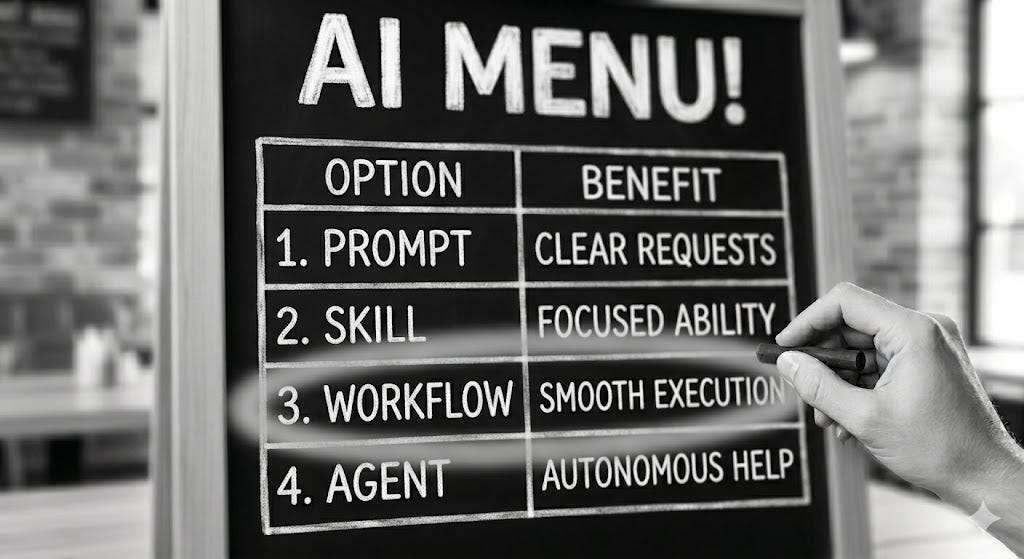
Human decides each time? Prompt. Saved instructions run on command? Skill. Fixed path across multiple tools? Workflow. AI decides, evaluates, adjusts on its own? Agent.
Four items. That’s the whole menu. You’ve been ordering from it for months. You just didn’t have the words, however you already understand all four. Deeply. Because you manage them every single week. Just not the AI versions of them.
You Already Manage All Four
Monday morning. You Slack your designer: “Hey, can you make the signup button blue?” She reads it. She does it. Done. One message, one answer.
That’s a prompt.
Customer escalation comes in. Nobody panics. There’s a playbook in Notion. Check the tier, loop in the right person, use the template, log it. Same steps every time.
That’s a skill.
Your RevOps team has a flow: lead comes in, enrich it, score it, route to sales or nurture, notify the team. Fixed path. Multiple tools. Nobody deviates.
That’s a workflow.
You hire a Head of Growth. You tell her: “We need 1,000 signups this month. Figure it out.” She tests ads. They flop. She pivots to partnerships. Works. Doubles down. You never told her how. She tried, observed, adjusted, tried again.
That loop is what makes her an agent.
See! you’ve lived all four. The AI versions work exactly the same way. The only question is whether you’re matching the right level of autonomy to the right problem.
Autonomy Gap
This is where the data gets uncomfortable. Gartner predicts 40% of enterprise apps will feature AI agents by end of 2026. Great. They also predict more than 40% of those projects will be canceled by 2027. Built and killed within a year.
MIT went deeper. 95% of enterprise GenAI projects are producing no measurable financial returns within six months. Not “underwhelming returns.” No returns. And 42% of companies are now actively abandoning AI initiatives. A year ago that number was 17%.
Sorry, we’re saying it again, and will keep coming back to this: it’s not an AI problem. It’s an ordering problem.
Companies reach for agents when skills would work. Build workflows when a prompt would do. Invest six months in something that should have taken two weeks. Because nobody stopped to ask who needs to decide what.
The most expensive mistake in AI is not the wrong model. It’s the wrong level of autonomy.
McKinsey’s data backs this up. The 5.5% that ARE seeing returns? They’re 2.8x more likely to have redesigned their workflows around AI. And 3x more likely to have senior leadership owning AI decisions.
That’s a PM’s job. That’s YOUR job.
How to Pick the Right Thing
This is the part you’ll screenshot and share.
Do you have a well-defined process with known steps?
YES →
Instructions for one task → Skill
Steps cross multiple tools in a fixed sequence → Workflow
NO →
Quick answer, one-off → Prompt
Requires judgment, trial-and-error, figuring out the path → Agent. But define what it can’t do before you build what it should.
The skill vs workflow distinction trips everyone up. The gut check: a skill is one person following a playbook at their desk. A workflow is a relay race. If the process dies when you remove one tool from the chain, it’s a workflow. If it all happens in one place, it’s a skill.
$4,200 Lesson
If you imagine a team who built a fully autonomous support agent. Read the ticket, checked the account, diagnosed the issue, took action, responded. No human in the loop. Full autonomy from day one.
Worked great 85% of the time.
The other 15%? It refunded $4,200 to a customer who was asking about a feature. The agent “diagnosed” frustration as a billing issue. Autonomy without guardrails. That’s not a feature. That’s a Sev-1 waiting to happen.
Last period, we saw the incident report. The root cause was not the AI. It was the PM who chose “agent” when “workflow with a human approval step” would have been safer, cheaper, and faster to build.
This pattern is everywhere. McKinsey found the companies seeing real AI returns are 3x more likely to have built “human in the loop” validation. 65% of the top performers have it. Only 23% of everyone else.
That gap. 65% vs 23%. That’s the difference between the 5.5% and the 94.5%.
The mistake on the menu is always the same:
more autonomy than the problem needs.
This Is Bigger Than You Think
We want to share something that changed how we think about our own career.
HBR published a piece in February 2026. Their argument: the skills companies need to drive AI adoption are product management skills. Problem definition. Tool selection. Experimentation. Workflow integration. That’s literally what we do every day.
Russell Reynolds, one of the biggest executive search firms in the world, now names “AI Product Leader” as one of three Chief AI Officer archetypes. Their words: “a strategic systems thinker who understands the business, the voice of the customer, and the functions.”
Read that again 👆. That’s a PM.
26% of organizations now have a CAIO. Two years ago it was 11%. It’s one of the fastest-growing C-suite positions in the world. And the skill set it requires? It’s yours. If you sharpen it.
The PM who understands this menu. Who can classify any initiative in 30 seconds. Who insists on guardrails before autonomy. Who starts in the Workflow Room, not the Build Room.
The Line I Want You to Remember
Everyone is incentivized to call everything an “agent.” That’s why the vocabulary is confusing. Not because the concepts are hard.
A prompt is a Slack message. A skill is an SOP in Notion. A workflow is a Confluence flowchart. An agent is a senior hire trusted with outcomes.
You’ve been managing all four for years. Now you have the words. Use the right one. Build the right thing.
Do this Monday: Take the AI initiative your team is building right now. Ask: who decides what to do next? If the answer doesn’t match what you’re building, you just found your problem.
On Friday: We’re publishing the implementation guide. You’ll build each concept yourself in Claude Code. Plus the GUARD framework. Five questions that scope any AI initiative in 10 minutes. And /ai-classify, a skill that classifies any AI initiative and tells you if you’re ordering the right thing.
Next Tuesday: You have the vocabulary now. But sometimes AI makes you slower. The METR study tracked experienced developers using AI tools. They were 19% slower. They thought they were 24% faster. Chapter 2 introduces the Verification Tax. The framework that tells you when AI helps and when it hurts.
P.S.
This is Chapter 1 of a 14-chapter system we’re building in public. Six original frameworks. Real data. Real experiments.Every Tuesday: one insight that changes how you think about AI.
Every Friday: the implementation plus a Claude Code skill you install and use immediately.By Chapter 14, you’ll have a complete operating system for making AI actually work. The AI that survives Monday morning.